When a car hits a person, a common assumption is that if the pedestrian wasn't in a crosswalk, they are automatically to blame. However, determining pedestrian accident fault in Houston is rarely that simple. The driver of the vehicle can still be held partially or even entirely responsible, even if the pedestrian was jaywalking. The law recognizes that everyone on the road, including drivers, has a responsibility to be aware of their surroundings and act with reasonable care to prevent collisions.
It all comes down to the specific details of the incident. Was the driver speeding, texting, or otherwise distracted? Could they have reasonably seen the pedestrian and stopped in time? These questions are central to understanding who is truly responsible, something a Houston pedestrian accident lawyer evaluates when a peaceful walk through a neighborhood like The Heights or a quick dash across a street in Montrose ends in injury.
Key Takeaways about Who’s at Fault in a Houston Pedestrian Accident: Jaywalking vs. Negligent Driver
- Establishing pedestrian accident fault in Texas involves a detailed look at the actions of both the driver and the person who was on foot.
- Texas law applies a "proportionate responsibility" rule, also known as comparative negligence, which allows fault to be shared between parties.
- A driver has a legal duty to exercise due care to avoid hitting pedestrians, regardless of whether the pedestrian is in a crosswalk.
- A pedestrian injured while jaywalking may still be able to recover financial compensation if the driver is found to be 51% or more at fault.
- Evidence such as traffic camera footage, witness accounts, and police reports is vital for accurately assigning responsibility in these cases.
The Common Misconception: Is a Jaywalking Pedestrian Always at Fault?
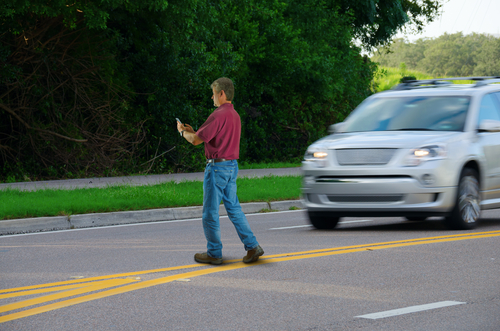
Many people believe that if you are hit by a car while crossing the street outside of a designated crosswalk, you have no legal options. This is one of the most persistent and damaging myths surrounding pedestrian injuries. While it's true that pedestrians have a duty to follow traffic laws, this doesn't give drivers a free pass to ignore people in the road. Pedestrian accident fault in a pedestrian accident claim is a two-way street.
The core of the issue lies in a legal concept called "duty of care." Every driver in Texas has a fundamental responsibility to operate their vehicle safely and be vigilant for potential hazards, including people.
Think about these common scenarios in Houston:
- A driver is speeding down Westheimer Road at night and fails to see someone crossing mid-block until it's too late.
- A driver is replying to a text message while approaching an intersection and doesn't notice a person step off the curb.
- A driver in a large truck or SUV with significant blind spots fails to check their surroundings before turning.
In each of these situations, the driver's actions contributed to the collision. Even if the pedestrian was not in a crosswalk, the driver’s failure to act with reasonable care could make them legally responsible for the resulting injuries.
Understanding Texas Pedestrian and Crosswalk Laws
To properly understand pedestrian accident fault, it's helpful to know what the law actually says. The Texas Transportation Code outlines the specific duties and responsibilities for both pedestrians and drivers. These laws provide the framework that insurance companies and courts use to analyze an incident.
The Texas crosswalk laws give pedestrians the pedestrian right of way in certain situations, but not all. At the same time, the law places a clear duty on drivers to remain watchful. In Texas, a driver must "exercise due care to avoid colliding with a pedestrian on a roadway."
Here are a few key rules to remember:
- At Crosswalks: When traffic signals permit, drivers must yield to pedestrians in marked or unmarked crosswalks at an intersection.
- Outside Crosswalks: If a pedestrian crosses a street at any point other than a marked crosswalk or an intersection, they must yield the right-of-way to vehicles.
- Sudden Movements: Pedestrians cannot "suddenly leave a curb or other place of safety and walk or run into the path of a vehicle that is so close that it is impossible for the operator to yield."
These laws show that responsibility is shared. A pedestrian has a duty to be careful, but a driver’s duty to pay attention and avoid a crash is always present.
The Deciding Factor: Comparative Negligence in Texas
The most important legal principle for understanding pedestrian accident fault is comparative negligence, which Texas officially calls "proportionate responsibility." This rule is the reason a pedestrian can be partially at fault for an accident and still receive compensation.
In simple terms, comparative negligence is a system for dividing fault between everyone involved in an accident. After a collision, an investigation will determine the percentage of blame that belongs to each person. A person’s carelessness or failure to act reasonably is called “negligence.”
For example, a jury might decide that a pedestrian who was looking at their phone while crossing mid-block was 30% negligent, while the driver who was going 15 miles per hour over the speed limit was 70% negligent, which is often when people realize they need a pedestrian accident attorney. The law acknowledges that very few accidents are 100% one person’s fault.
How Texas's 51% Bar Rule Affects Pedestrian Accident Fault
Texas follows a specific type of this rule known as the "51% Bar Rule." This rule is critical to your ability to recover money for your injuries.
Here is how the 51% bar rule works:
- You can recover damages as long as your percentage of fault is 50% or less.
- Your total compensation will be reduced by your percentage of fault.
- If you are found to be 51% or more at fault, you are barred from recovering any money at all.
Let's look at a few examples with a hypothetical $100,000 in damages:
- Pedestrian is 25% at fault; Driver is 75% at fault. The pedestrian can recover $75,000 (the original $100,000 minus their 25% share of fault).
- Pedestrian is 50% at fault; Driver is 50% at fault. The pedestrian can recover $50,000 (the original $100,000 minus their 50% share of fault).
- Pedestrian is 51% at fault; Driver is 49% at fault. The pedestrian recovers $0.
This rule makes it incredibly important to conduct a thorough investigation to accurately determine the pedestrian accident fault and challenge any unfair blame placed on the injured person.
What Factors Determine a Driver’s Negligence?
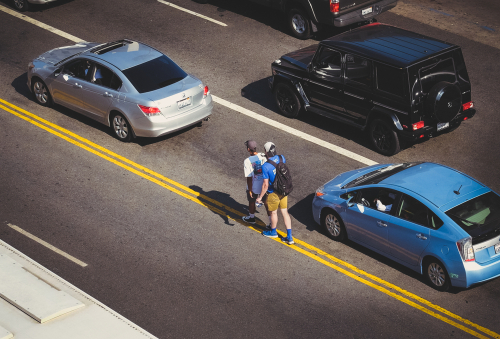
Since the driver's percentage of fault is so important, a huge part of any pedestrian injury claim is investigating what the driver did wrong, including the common causes of pedestrian accidents. An insurance adjuster or a jury will look at many factors to decide if the driver failed to exercise the reasonable care required by law.
Several common driver behaviors can shift the pedestrian accident fault in favor of the injured person.
- Distracted Driving: This is a leading cause of all types of accidents. Using a cell phone, eating, or even talking to passengers can take a driver's focus off the road.
- Speeding: Driving faster than the posted speed limit, or too fast for conditions like rain or fog, dramatically reduces the time a driver has to react to a pedestrian.
- Driving Under the Influence (DUI): Alcohol or drugs impair a driver's judgment, vision, and reaction time, making them a significant danger to anyone on or near the road.
- Failing to Obey Traffic Laws: Running a red light or a stop sign, or making an illegal turn, clearly demonstrates driver negligence.
- Driver Fatigue: Drowsy driving can be just as dangerous as drunk driving, slowing a driver's ability to process information and react to a hazard.
Any of these factors can prove that a driver was not paying attention or was operating their vehicle recklessly, which can result in them shouldering the majority of the blame for the collision.
Gathering Evidence to Establish Pedestrian Accident Fault
You can’t just say a driver was negligent; you have to prove it. A successful personal injury claim depends on gathering strong, clear evidence that tells the story of what really happened. A detailed investigation can uncover facts that show the driver was primarily responsible, even if you were crossing outside of a crosswalk.
Key Pieces of Evidence in a Houston Pedestrian Accident Case
After an accident, a legal team works to collect and preserve all evidence that can help establish pedestrian accident fault.
Here are some of the most important types of evidence:
- The Official Police Report: This document contains the responding officer's notes, diagrams of the scene, witness information, and their initial assessment of fault.
- Witness Statements: Independent witnesses who saw the accident can provide an unbiased account of events, including the driver's speed or a pedestrian's location.
- Photos and Video Footage: Pictures of the scene, the vehicle's damage, and your injuries are powerful. Even more valuable is video from nearby traffic cameras, doorbell cameras, or business security systems.
- The Driver's Cell Phone Records: If distracted driving is suspected, phone records can sometimes show if the driver was texting, emailing, or on a call at the exact moment of the crash.
- Accident Reconstruction Analysis: In complex cases, professionals can use physics and engineering principles to recreate the accident. They can calculate vehicle speed, angles of impact, and visibility to provide a scientific opinion on how the collision occurred.
This evidence is pieced together to build a complete picture of the incident, which is crucial for proving the driver's share of responsibility and understanding how long pedestrian accident claims take to settle.
Pedestrian Accident Fault FAQs
Here are answers to some common questions people have about determining fault after being hit by a car.
What if the driver says the sun was in their eyes?
Drivers are expected to account for environmental conditions. If the sun's glare is a problem, a reasonable driver should slow down, use their sun visor, or take other precautions. Claiming they couldn't see is often not a valid excuse and can even be an admission of careless driving.
Does it matter what I was wearing at the time of the accident?
The color of your clothing, especially at night, can sometimes be a factor in determining comparative negligence. An insurance company might argue that dark clothing made you harder to see. However, this does not erase the driver's fundamental duty to be alert and watchful for hazards on the road.
Can a child be found at fault for a pedestrian accident in Texas?
The law holds children to a different standard than adults. A very young child is generally considered incapable of negligence. An older child's actions would be compared to what a reasonably careful child of the same age and experience would do. Drivers are also expected to exercise a higher degree of caution in areas where children are likely to be present, like near schools and parks.
What is an "unmarked crosswalk" in Texas?
An unmarked crosswalk exists at any intersection where two streets meet at approximately right angles. It is the part of the road that would connect the sidewalks on opposite sides of the street. Pedestrians generally have the right-of-way in these unmarked crosswalks, just as they do in marked ones.
How long do I have to file a claim for a pedestrian accident in Houston?
In Texas, the general time limit, or "statute of limitations," for filing a personal injury lawsuit is two years from the date of the accident. It is important to understand this deadline, as waiting too long could prevent you from ever seeking compensation for your injuries.
Let the Suits & Boots Team Investigate Your Case

Determining pedestrian accident fault is a complex process that requires a deep dive into the facts. It’s not about pointing fingers; it’s about uncovering the truth and holding the responsible party accountable. The initial story from the driver or the police report doesn't always reflect what really happened.
At Suits & Boots Accident Injury Lawyers, we understand that you need real answers. That’s why we offer a No Cost, No Obligation 30-Day Investigation. We put in the work to gather the evidence, analyze the laws, and give you a clear picture of your case. We use our Max Money Method to build the strongest possible claim, so you can focus on your recovery. The WORK of the BOOTS and the SKILL of the SUITS are here to fight for the full and fair compensation you deserve.
Claim or start your free, no-obligation 30-Day Investigation by contacting us at (713) 489-0922 or through our online form.