The phone rings. It’s a number you don’t recognize, but you answer anyway. On the other end is a friendly, concerned-sounding person from the other driver’s insurance company. They ask how you’re doing, say they just want to get your side of the story, and ask if you’d mind if they record the call. It all seems so simple and helpful. But this first conversation is one of the most critical moments in your personal injury claim.
Insurance adjusters are trained to conduct these calls in a very specific way. Their goal is to protect their company's bottom line by finding reasons to reduce the value of your claim or deny it completely. They know what to ask and how to ask it to get you to say things that can unintentionally harm your case.
This is why having a plan—and even an insurance adjuster recorded statement script—is so important. It’s not about being uncooperative; it’s about protecting your rights and ensuring the full story of your injuries and losses is told accurately when the time is right. A personal injury lawyer in Houston can help you navigate these calls and safeguard your claim.
Key Takeaways about How to Effectively Shut Down an Insurance Adjuster
- An insurance adjuster's primary role is to minimize the financial payout for their company.
- Providing a recorded statement to an at-fault driver's insurance company is typically not required by law in Texas.
- Certain seemingly innocent questions are designed to get a person to unintentionally weaken their own injury claim.
- Using a prepared insurance adjuster recorded statement script can help protect a person's legal rights during these conversations.
- Anyone handling an injury claim must understand the purpose behind an adjuster's tactics.
- You are better off referring an adjuster to your lawyer than trying to answer their questions.

The Real Reason an Insurance Adjuster Wants a Recorded Statement
When an adjuster asks to record your conversation, it isn't just for their records. That recording becomes official evidence. The primary purpose is to lock you into a story very early on, before you may know the full extent of your injuries or have had time to process the details of the accident.
They listen for anything they can use against you later. This could be a small inconsistency between what you say on the call and what you say months later in a deposition (a formal, pre-trial interview under oath).
This legal tactic is sometimes called "impeachment by prior inconsistent statement." In simple terms, it means they use your own words from an early recording to make it seem like you're changing your story, which can damage your credibility.
Remember, the adjuster from the other driver's insurance company works for them, not for you. Their job is to resolve the claim for the lowest possible amount. While many adjusters are professional, their financial interests are directly opposed to yours.
In Texas, you generally do not need to provide a recorded statement to the other party’s insurance provider. You have the right to control what information you share and when.
The 5 Trick Questions and Your Insurance Adjuster Recorded Statement Script
Below are five of the most frequent trick questions adjusters use, why they ask them, and a precise, respectful script you can use to respond. This is the kind of practical, recorded statement advice Texas residents need to level the playing field.
Trick Question #1: "How are you doing today?"
This sounds like simple politeness, but it’s a loaded question. If you answer "I'm fine" or "I'm okay," the adjuster will note it in your file. Later, if you are still dealing with serious pain, their lawyer might say, "But on the day after the accident, you told our adjuster you were 'fine'."
- The Trap: To get you to downplay your injuries with a socially conditioned, automatic response.
- Your Script: ”I am still getting medical care and focusing on my recovery. I will provide full details about my condition after my doctor confirms them."
This response is truthful, polite, and doesn't minimize your condition. It establishes that you are hurt without providing specific details that the insurer could use to limit your claim later on.
Trick Question #2: "Can you tell me in your own words what happened?"
This open-ended question is an invitation to speculate, get emotional, or accidentally say something that implies you were partially at fault. You might say, "I didn't even see them coming," which they could twist to mean you weren't paying attention. Or you might guess at speeds and distances, which could later be proven inaccurate.
- The Trap: To get you to offer opinions, guesses, or admissions instead of sticking to the hard facts.
- Your Script: "The official accident report contains the details of the collision. I was traveling on [street name] when the other vehicle struck my car. I'm not going to speculate on anything beyond the basic facts at this time."
This script shows you are being cooperative by providing basic information, but wisely avoids creating a narrative that can be picked apart. It refers them to an official document and keeps you from being your own worst witness.
Trick Question #3: "So you were just heading to the store? You weren't in a hurry?"
These are leading questions. They are designed to suggest a narrative—that you were rushed, distracted, or otherwise acting carelessly—and get you to agree with it. Whether you were late for a meeting or just taking a Sunday drive down Memorial Drive makes no difference to the other driver's responsibility, but the adjuster wants to plant seeds of doubt.
- The Trap: To get you to agree to a characterization of your actions that implies you share some of the blame for the accident.
- Your Script: "I was operating my vehicle safely and obeying traffic laws."
This is a complete answer. It’s direct, factual, and doesn't engage with the adjuster's line of questioning. You don't need to justify where you were going or what your mindset was.
Trick Question #4: "Were you injured? Can you list all of your injuries for me?"
This is one of the biggest pitfalls. Right after an accident, you may not be aware of all your injuries. Adrenaline can mask pain, and some serious conditions, like whiplash, soft tissue damage, or even a traumatic brain injury, can take days or weeks to fully present symptoms. If you provide a list of injuries and another one appears later, the insurer will argue they aren't responsible for it because you didn't mention it in the initial recorded statement.
- The Trap: To get you to create a "complete" and final list of your injuries before they have all been diagnosed by a medical professional.
- Your Script: "I was injured in the accident and am currently under a doctor's care. We are still working to determine the full extent of my injuries."
This script confirms that you were hurt and are seeking treatment, which is crucial for your claim. However, it correctly states that the full medical picture is not yet clear, preserving your right to claim compensation for all injuries that arise from the accident.
Trick Question #5: "We just need this recorded statement to move forward with your claim and get you paid. Can we proceed?"
This question uses a sense of urgency and obligation to pressure you. It frames the recorded statement as a simple, required step for your benefit. While the insurance company does need information to process a claim, a recorded statement from you is primarily for their benefit—to gather evidence they can use to challenge your claim.
- The Trap: To make you feel that giving a statement is the only way to get your claim processed and that you must do it right now.
- Your Script: "I am not prepared to give a recorded statement at this moment. I can provide you with my basic contact information, but please direct all other communications to me in writing at my address."
This is a polite but firm way to decline and take control of the conversation. It creates a written record of your communications, which is always a good practice, and gives you the time and space to consider your next steps without pressure. Using this part of the insurance adjuster recorded statement script is your right.
What to Do (And Not Do) During the Call
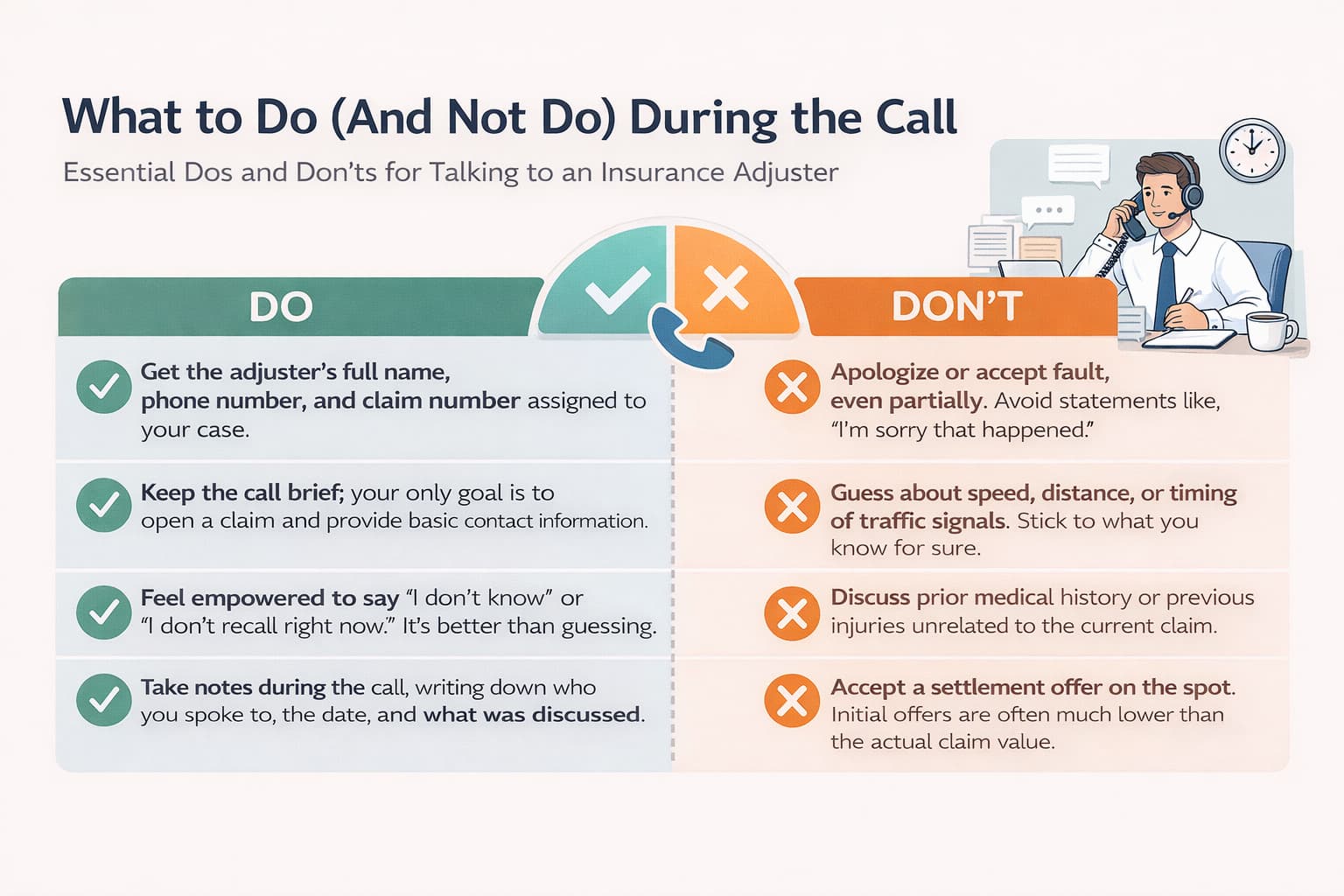
Beyond having a script, a few key behaviors can protect you during any phone call with an insurance adjuster.
Here is a simple list of best practices:
- DO get the adjuster’s full name, direct phone number, and the claim number they have assigned to your case.
- DO keep the call as brief as possible. Your only goal is to open a claim and provide basic contact information.
- DO feel empowered to say, “I don’t know” or “I don’t recall right now.” It is much better than guessing.
- DO take notes during or immediately after the call, writing down who you spoke to, the date, and what was discussed.
Here are some things to avoid:
- DON’T apologize or say anything that sounds like an apology, such as “I’m so sorry that happened.” In Texas, liability for an accident can be shared under a legal rule known as proportionate responsibility. Admitting even a small amount of fault can significantly reduce the compensation you can recover.
- DON’T guess about facts like speed, distance, or the timing of traffic signals. Stick to what you know for sure.
- DON’T discuss your prior medical history or any previous injuries. The adjuster is only entitled to information directly related to this accident.
- DON’T accept a settlement offer on the spot. Initial offers are almost always far lower than the actual value of a claim.
Following these simple rules can make a significant difference in how the insurance company handles your claim.
Recorded Statement Advice Texas: Know Your Rights
It's critical to understand how Texas law applies to your situation. The advice to politely decline a recorded statement is aimed specifically at the at-fault driver's insurance company. The situation can be different with your own insurer.
Your own auto insurance policy is a contract. This contract likely contains a "duty to cooperate" clause. This means you may be required to provide a statement to your own insurance company for things like a UM/UIM (uninsured/underinsured motorist) claim or a collision claim for your vehicle repairs.
Even in this case, you may take your time and speak with a legal professional before giving a statement. It’s wise to review your policy or ask for guidance to understand your specific obligations.
The Texas Department of Insurance (TDI) provides a Consumer Bill of Rights that outlines how insurance companies are expected to behave. They are required to treat you fairly and act in good faith.
Beyond the Script: When You Need More Than Words
An insurance adjuster’s recorded statement script is a powerful tool, but it's a defensive one. It helps you avoid mistakes, but it doesn't build your case for you. Insurance adjusters are skilled negotiators with vast resources, and they handle hundreds of claims every year. If your case involves any of the following, it may be time to seek professional guidance:
- Significant Injuries: If your injuries require surgery, ongoing physical therapy, or have resulted in permanent impairment.
- Disputed Fault: If the other driver's insurance company is denying responsibility or trying to place the blame on you.
- Lowball Offers: If the settlement offer you receive doesn't come close to covering your medical bills, lost wages, and other damages.
- Complex Cases: Accidents involving commercial trucks, drunk drivers, or multiple vehicles often involve more complicated legal and insurance issues.
An experienced personal injury law firm can take over all communication with the insurance company, conduct a thorough investigation, gather the evidence needed to build a strong claim, and fight for the full compensation you deserve.
Insurance Adjuster Recorded Statement Script FAQs
Here are answers to some common questions people have about dealing with insurance adjusters after a car accident in Houston.
What if I already gave a recorded statement?
If you have already provided a recorded statement, don't panic. While it can't be taken back, a skilled attorney can still help. They can obtain a copy of the transcript, review it for any problematic answers, and develop a strategy to clarify your statements and prevent the insurance company from misusing your words.
Can an insurance company use my social media against me?
Yes, absolutely. Adjusters and investigators frequently look at claimants' social media profiles. A picture of you at a family barbecue or a post about going on a walk could be used to argue that your injuries are not as severe as you claim. It is wise to set all your social media profiles to private and avoid posting anything about your accident or your recovery.
How long does an insurance company have to settle a claim in Texas?
Texas law has "prompt payment" laws. Generally, after receiving a claim, an insurer must acknowledge it within 15 business days, begin an investigation, and accept or reject the claim within 15 business days after receiving all necessary information. However, they can extend these deadlines, and the process can still take a long time.
Should I sign a medical authorization release for the insurance adjuster?
No. These forms often give them permission to access your entire medical history, not just the records related to the accident. They will look for any prior injuries or conditions to argue that your current pain is from a pre-existing issue. It's best to first review any authorization form with an attorney.
Is it okay to just give basic information like my name and address?
Yes, providing basic, factual information is perfectly fine and often necessary to get the claim process started. You can confirm your full name, address, and phone number. You can also provide the date and location of the accident and identify your vehicle. The key is to avoid discussing details about how the accident happened, your injuries, or your medical treatment.
What is the deadline for filing a car accident lawsuit in Texas?
The deadline is set by a rule called the Statute of Limitations. In Texas, you generally have two years from the accident to file a personal injury lawsuit. If you fail to file a claim within this period, a court can forever bar you from recovering compensation.
Certain circumstances can change this deadline, so you must speak with a legal professional right away to protect your rights.
What types of compensation can I seek after an accident?
You can seek compensation, often called damages, for all losses caused by the negligent driver. These damages typically fall into two main categories. Economic damages cover verifiable monetary losses, such as past and future medical bills, lost wages, and property damage. Non-economic damages cover intangible losses, such as pain and suffering, mental anguish, and loss of enjoyment of life.
How does an attorney help my case if I follow the script?
While the script helps you avoid mistakes, a legal professional does more than just shield you from trick questions. A knowledgeable attorney builds your case. They investigate the crash, manage deadlines, hire necessary professionals (like accident reconstructionists), correctly calculate all of your damages, and negotiate with the insurance company.
This comprehensive approach maximizes your compensation and removes the burden of fighting the insurer from you.
Let the Suits & Boots Team Handle the Insurance Company
You've been through enough. Dealing with a painful recovery is hard work, and you shouldn't have to fight with an insurance company at the same time. The team at Suits & Boots Accident Injury Lawyers was founded to be different. We combine the tireless WORK of the BOOTS with the refined SKILL of the SUITS to stand up for people in Houston.

We know the insurance company’s playbook because we’ve seen it from every angle. Our unique Max Money Method is a proprietary process designed to get you the maximum compensation for your injuries, both at the end of your case and with immediate financial help along the way. Let us take over the phone calls, the paperwork, and the fight, so you can focus on what truly matters: getting better.
Claim or start your free Investigation with our team today. There’s no cost and no obligation for us to spend up to 30 days digging into your case to give you real answers.